
-
- Brassicas, Vegetables
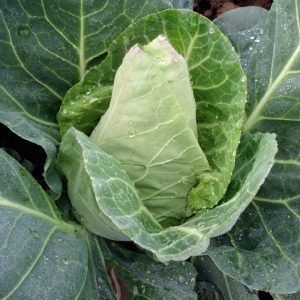
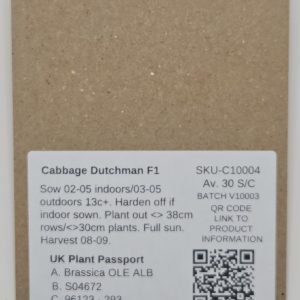
Cabbage Dutchman F1 – Av. 30 Seeds
- £2.55
- Dutchman is a mild and sweet 'Duchy' type cabbage. It is a good cropper and perfect for growing at reduced spacings to produce 'baby' cabbages, this also means it is ideal for growing in smaller gardens or where space is limited. The variety displays good disease resistance and tolerance to bolting and splitting, producing tender, pointed heads. Medium size with…
- Add to basket
-
- Brassicas, Vegetables
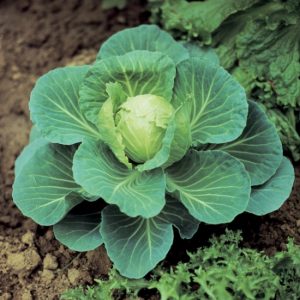
Cabbage Golden Acre – Seeds – Av. 200
- £1.50
- Golden Acre is an old heirloom variety, that produces dense, grey-green heads. References to it can be found in seed catalogues as early as 1927. It’s a first-early cabbage and grows quickly, so slugs and other pests don’t have much time to affect more mature plants. Slow to bolt and vigourous, with 5 to 6 inch round heads, It is…
- Add to basket
-
- Brassicas, Vegetables
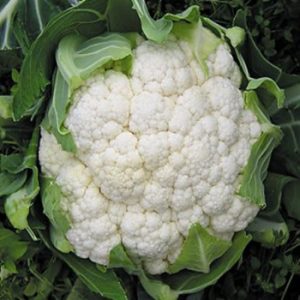
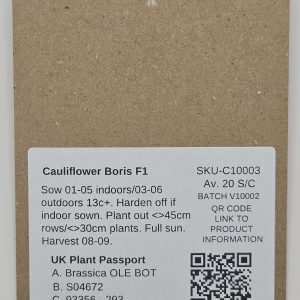
Cauliflower Boris F1 – Av. 20 Seeds
- £2.65
- Cauliflower 'Boris' F1 is a resilient, fast-maturing variety known for producing uniform, dense white curds and is a good choice for beginners due to its adaptability to various conditions. SKU C10003 Av. 20 Seeds
- Add to basket
-
- Brassicas, Vegetables
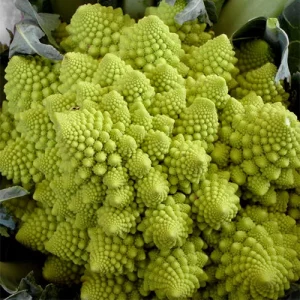
Cauliflower Romanesco – (Av. 250 Seeds)
- £1.35
- An unusual shaped cauliflower, Romanesco produces excellent, appetising light green curds. The evenly shaped cauliflower heads are good sized and very solid, producing great cauliflowers for that Sunday lunch or eaten raw with dips.
- Add to basket
-
- Hardy Perennials, Trees/Shrubs
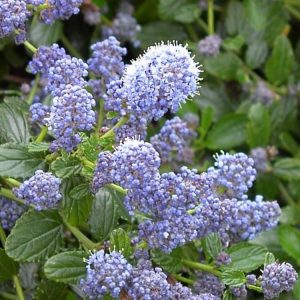
Ceanothus ‘A T Johnson’ Californian Lilac – Hardy Perennial 2L
- £12.00
- Ceanothus A T Johnsons is an upright evergreen shrub with finely toothed, glossy, bright green leaves. It is a fast grower and is best pruned mid to late spring after flowering. An abundance of fragranced, brilliant blue flowers are produced in early summer and again in early autumn. Great for attracting pollinators into the garden, attracts butterflies and many other…
- Add to basket
-
- Books
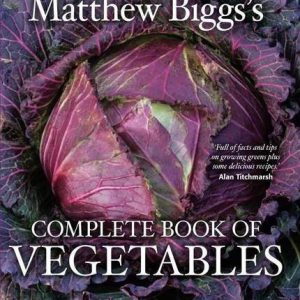
Complete Book Of Vegetables – Author Matthew Biggs – Pre-Loved ❤️
- £9.99
- Matthew Biggs has been a professional gardener for over 20 years. In this comprehensive book, he shares his extensive knowledge of a wide variety of vegetables and inspires the gardener to take on the fulfilling activity of vegetable growing. His advice is practical as well as encouraging and is applicable to the backyard, garden, greenhouse and kitchen. With an A-Z…
- Add to basket
-
- Hardy Perennials, Trees/Shrubs
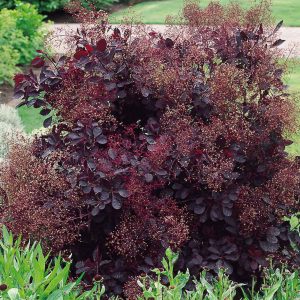
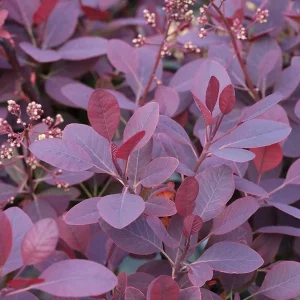
Cotinus coggygria ‘Royal purple’ (Smoke bush) – 2L Pot.
- £12.00
- Cotinus coggygria 'Royal Purple' is a hardy deciduous shrub. Foliage of deep rounded red-purple leaves that turn a vivid and more red shade, during the autumn months, having fluffy, smoke-like plumes of purplish-pink flowers in July and August. The smoke bush makes an eye-catching specimen plant for a sunny shrub or mixed border, with foliage which appears almost translucent when…
- Add to basket
-
- Bulbs and relatives, Flowers (Plants), Hardy Perennials
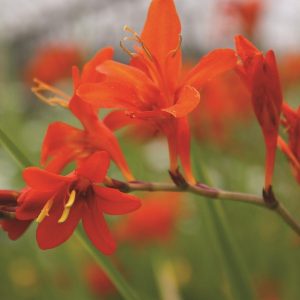
Crocosmia ‘Lucifer’
- £12.00
- Regarded as one of the hardiest cultivars, 'Lucifer' adds a tropical flair to northern gardens. Beginning in midsummer and continuing into early fall in some climates, brilliant flame red flowers stand in rows on wiry, gracefully arched stems that are perfect for cutting. Crocosmia's broad, sword-like leaves are attractive even when the plants are not in bloom and, from a…
- Add to basket
-
- Flowers (Plants), Hardy Perennials
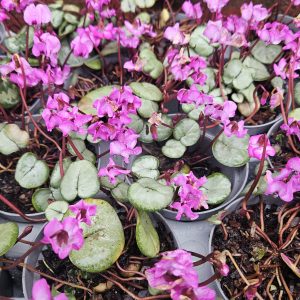
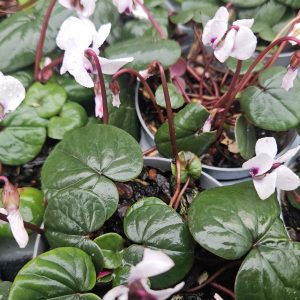
Cyclamen coum – Rose – Silver Leaf 8cm potted. (HP)
- £4.99
- The beautiful shell-shaped flowers are pale to dark magenta and sit atop a bed of silver marbled foliage. Flowers February to April. Height 10cm. Supplied in 8cm pot.
- Add to basket
-
- Flowers (Plants), Hardy Perennials
Cyclamen coum – White 8cm potted. (HP)
- £4.99
- The beautiful shell-shaped flowers are pale to dark magenta and sit atop a bed of silver marbled foliage. Flowers February to April. Height 10cm. Supplied in 8cm pot.
- Add to basket
-
- Bulbs and relatives, Dahlias, Flowers (Plants)
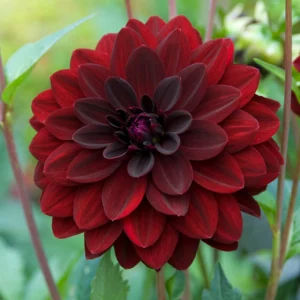
Dahlia – Arabian Night (Loose Tuber)
- £3.99
- Dahlia Arabian Night is striking dark red, it is sure to draw the eye to it’s huge blooms. Prized for it’s wonderful sized double flowers, and also the variation in form and depths of colour. Suitable for planting in sunny and partially shaded locations Suitable for growing in pots and containers Excellent for cut flowers Attracts butterflies Summer flowering time…
- Add to basket
-
- Bulbs and relatives, Dahlias, Flowers (Plants)
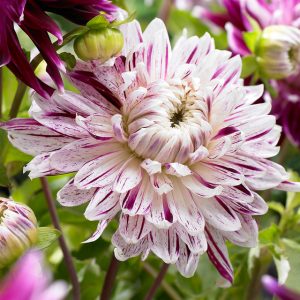
Dahlia – Avignon (Loose Tuber)
- £4.99
- Dahlia Avignon is striped with white and purple, with lighter purple speckles, it is sure to draw the eye to it’s huge blooms. A great choice for the summer garden, and as it grows quite tall, is perfect for displaying at the back of a border. Suitable for planting in sunny locations Suitable for growing in pots and containers Excellent…
- Add to basket





&url=https://borringtons.com/shop/seeds/vegetables-seeds/brassicas/cauliflower-romanesco-av-250-seeds/&media=https://borringtons.com/wp-content/uploads/ROMANESCO.webp)


%20–%202L%20Pot.&url=https://borringtons.com/shop/hardy-perennials/cotinus-coggygria-royal-purple-smoke-bush-2l-pot/&media=https://borringtons.com/wp-content/uploads/Cotinus_coggygria_Royal_Purple-1024x1024.jpg)

&url=https://borringtons.com/shop/flowers_plants/cyclamen-coum-rose-silver-leaf-8cm/&media=https://borringtons.com/wp-content/uploads/Cyc1-1024x768.jpg)
&url=https://borringtons.com/shop/flowers_plants/cyclamen-coum-white-8cm-potted/&media=https://borringtons.com/wp-content/uploads/cyc2-1024x768.jpg)
&url=https://borringtons.com/shop/bulbs-corms-tubers-rhizomes/dahlia-arabian-night-loose-tuber/&media=https://borringtons.com/wp-content/uploads/Dahlia_Arabian_Night_0002243_2__67547.webp)
&url=https://borringtons.com/shop/bulbs-corms-tubers-rhizomes/dahlia-avignon-loose-tuber/&media=https://borringtons.com/wp-content/uploads/Dahlia-Avignon.jpg)